Showing posts with label Family Catechesis. Show all posts

Sunday, December 25, 2011

Advent and Christmas 2011

"For just as lightning flashes and lights up the sky from one side to the other, so will the Son of Man be...." --Luke 17:24

A really good Advent sets up a really good Christmas, and we had a really good Advent this year. As we usually do, we set up the Christmas tree with a few strings of blue and purple lights (Advent colors), but nothing else. Actually, Jaybird had fun coloring and cutting out and hanging up Jesse Tree decorations, so for most of Advent our nearly-bare tree was decorated with those. In a nutshell, Jesse Tree symbols summarize salvation history leading up to the birth of Christ -- each symbol represents a different biblical story or episode.

We also lit the Advent wreath most nights; we sang a new verse of "O Come, O Come Emmanuel" every week, until we were able to sing the first four verses reasonably well. Even little Alleluia Boy was singing along in his own way by the end! Of course, we have read the Scripture readings for the day from the lectionary for years, so that was good too -- hearing all those very hopeful, poetically beautiful readings from Isaiah over several weeks leading up to Christmas.

We went to confession as a family, Advent being a penitential season and all.

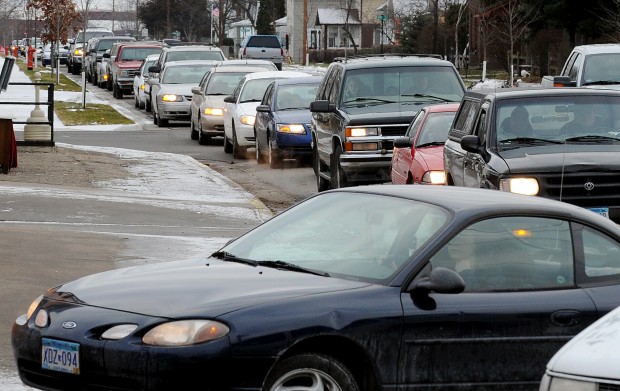
And on the day before Christmas Eve, the kids and I ran around town donating things. We saw this story in the Winona Daily News about the 600 families who received a free holiday basket from Winona Volunteer Services. Actually, a friend had driven past on the pickup day and then Facebooked about the line that stretched six blocks. Here's a picture from the Daily News:

That was the prompting we needed to head to the grocery store -- each child got to pick an item to donate. Mouse wanted to donate a 15-pound ham! I nixed that only because I wasn't sure whether they would accept perishable food, so she chose two jars of pickles instead. (Turns out the ham would've been okay -- oh well, next time!) Jaybird donated a bag of potatoes. And Bear donated a can of pineapple. We ran all that over to the food shelf, where it was weighed; we also dropped off a check. Then the kids got a five-minute tour of the food shelf. (Or as Mouse corrected: "Actually, we just stood around while you talked to the lady.") We found out that, indeed, nearly 1,000 families in our area rely on the food shelf once a month or more. That's nearly one in five families in this town. And that, frankly, is amazing.

We also donated a whole bunch of stuffed animals to another charity. Then it was off to Pizza Hut for a bit of a reward!

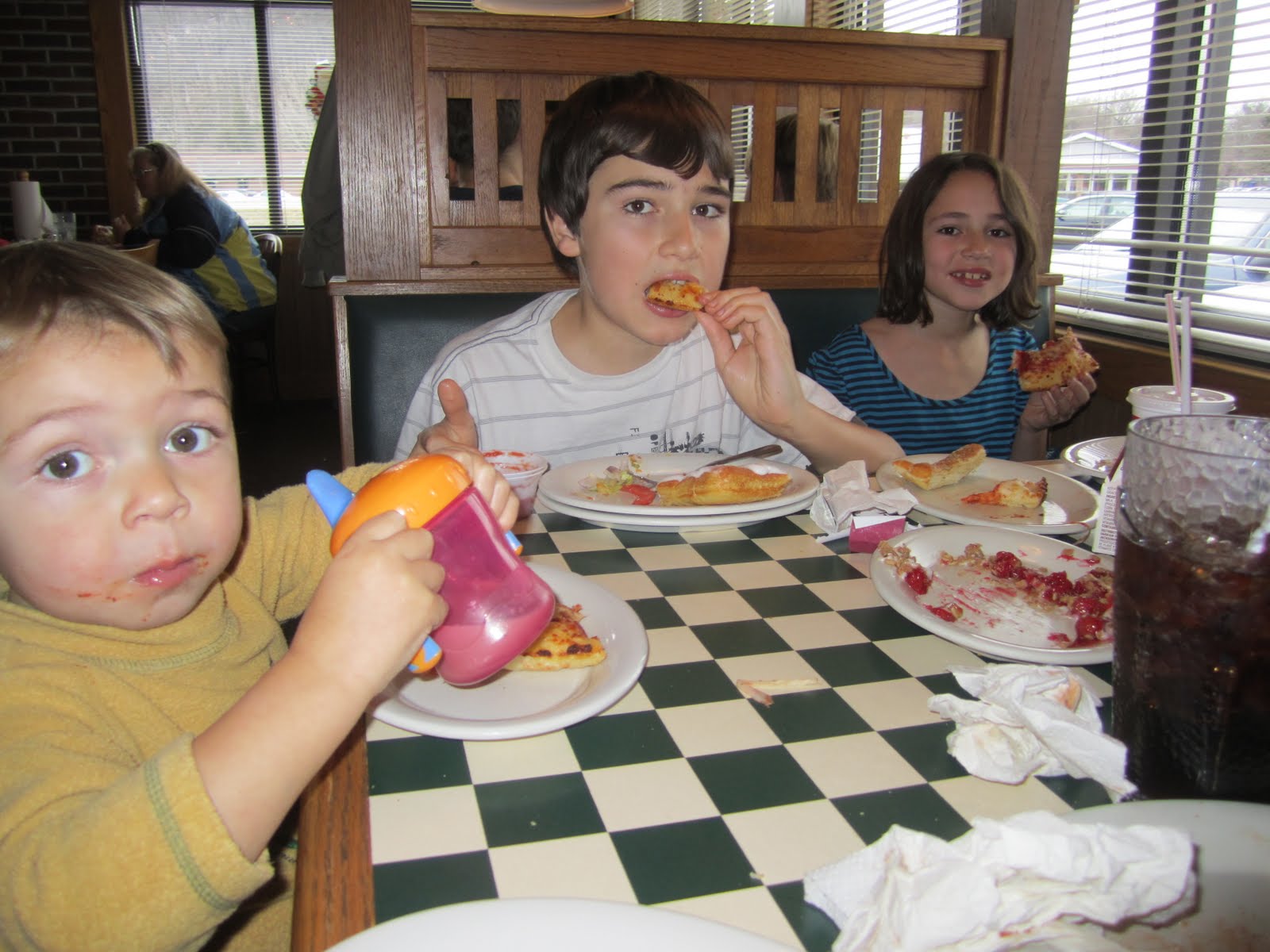

It was a buffet -- and this being Winona, that meant it was absolutely packed. But the kids enjoyed it anyway. The other thing we'd done in the week leading up to Christmas was to go through all their toys (again!) to organize them and to get rid of some of them. It was a lot of work (again), so the pizza out was well-deserved. By me especially. : )

That night we went down to La Crosse to see the Rotary Lights display in their park along the Mississippi River. This year, Alleluia Boy was properly impressed -- he kept looking around, wide-eyed, pointing out the "light, light!" We think he enjoyed it. And it was unseasonably warm and ice-free this year!


Bear's friend came along for the ride -- far left.

Christmas Eve morning, we decorated the tree with "real" lights and "real" Christmas decorations. It's a wonderful tradition...it really feels like a turning point, like we've come out of this period of darkness and penance into this time of light and joy.


The kids watched "A Charlie Brown Christmas" on DVD in the afternoon -- their one and only Christmas special. I have a special place in my heart for that special, because of Linus's speech on the true meaning of Christmas -- the birth of the Christ child. It was fun to hear the kids all laughing like crazy at Snoopy's antics. Some things are just classic!

Also Christmas Eve afternoon, our next door neighbor came over for a small gift exchange and cookies and milk. I shouldn't say "small," since she is always VERY generous with gift certificates to the local book store and Godfather's Pizza.


Another Christmas tradition for our family is Christmas Eve dinner at the local Catholic Worker house. Dinner was great -- ham, turkey, stuffing, and lots of great sides, including a wonderful squash soup. People were a little subdued, for understandable reasons, but there was still a lot of camaraderie and laughter. Bear and I ate with a new guy who regaled us with wonderful and amazing stories of his 19 years working as a carpenter in the Alaska wilderness.

We eat there every week, of course, so many of the regulars have become good friends. I persuaded them to pose for a picture after dinner:


Then it was homeward to get dressed for "Midnight" Mass -- at 8 p.m. (which is good, 'cause we couldn't do any later!). The girls dressed in their Christmas dresses:


Mass was wonderful -- the high point of Christmas, as usual. Although...

...Christmas morning was pretty nice, too.

This little guy had no idea that it was Christmas, but squealed with delight on
seeing the "horsey" anyway.


There is a story about the little prayer book Mouse is holding. I actually "hid" this gift and a few other small religious items too well -- and ended up spending about an hour and a half searching for them on Christmas Eve night, meaning that I didn't actually get to bed until early Christmas Eve morning!

The kids enjoyed all of their many gifts, as you can see in the video below.

We took time out for a walk in the nearby Trempealeau Wildlife Refuge just to get out of the house and to enjoy the beautiful weather. Everyone was in good spirits.


Here is the video of Christmas morning:


One of the highlights of the season for me was listening to Brother Mann, president of Saint Mary's University, deliver some brief remarks before the SMU Christmas dinner. He offered one of the best reflections on the Christmas season that I have heard in a while. The Scripture quotation at the beginning of this post was part of his remarks. I was really struck at the imagery in this quote, especially in the way he connected it to the incarnation.

The Gospel of John gives us that wonderful image of the Christ child as a light in the darkness, but I also like this image of Christ as a bolt of lightning spanning the sky. It really captures just how radical the Incarnation of God is...because if you really are so crazy as to believe in a God whose love for humanity is so great that he becomes one of us in order to draw us to him, then the Incarnation changes everything, absolutely everything. Like a flash of lightning in the night, it lights up our world and our lives, so that we see them as they truly are...and that is a good thing.

Sunday, April 03, 2011

Mass moments

Jaybird and Jackrabbit were both sick today (that's child #3 and Dad), so we did one of our split-shift Sundays.

Starling reports a couple cute moments from Mass. First, when our pastor lifted the cup at the consecration, Mudpuppy pointed and started making the sign for "drink."

Also, Bear got quoted in the homily. During confession yesterday, Father had asked him what he thought it would be like if he could see God the way the blind man in today's Gospel reading suddenly saw Jesus. "Well," he said, "it would be like this room was black and white in comparison." Father quoted this as part of his excellent homily, saying it came from one of our very own children.

Wednesday, February 02, 2011

Nonviolence

It has been a while since I last blogged about our family faith formation efforts. We still participate in GIFT, including the home curriculum, and we still do family prayer almost every night. Usually this involves reading the day's Gospel and then having a very short, impromptu lesson about it. In the past few weeks, we've also had the opportunity to talk a lot about nonviolence.

I suppose a warning is in order here -- we're about to wade into my strongly held opinion, boldly stated. Not so many cute kid photos here, although I will touch on the kids again in a moment.

Nonviolence is a theme we have really emphasized in our family, because nothing (IMHO) is quite as blasphemous as the idolatry of violence -- making violence into a god by depending on it as the solution to our problems. Believing that violence is sometimes a "necessary evil" seems to me to deny the reality of the resurrection. If we really believe that God has conquered sin and death, and if we really believe in eternal life, and if we really believe that our focus should be on becoming good and holy people rather than controlling the time and circumstance of our death, and if we really believe that we should not fear anyone or anything because God is with us, and if we really believe that we become more fully human by loving others and less human when we hate others, then people, why should we believe in violence?

I admit that all of us, me included, sometimes resort to violence out of habit, or because we can see no other solution. There is something to be said for being gentle on ourselves when this happens; just as we don't hold a small child fully responsible for his actions because of his lack of maturity, wisdom, discretion, and self-control, I think there is reason to be patient with ourselves and our society when we resort to violence. In a lot of ways, I don't think most of us are strong enough, smart enough, or mature enough to fully embrace nonviolence. Unfortunately, too often we don't even try. We see the alternatives as "too difficult" or "too complicated" or "too costly," and we wimp out. Violence is always the shortcut solution; as the Church repeatedly tells us, violence is never necessary, even if we're too dunderheaded to see or to pursue the alternatives. And like all shortcut solutions, we're the ones who get cut in the end.

So, as I was saying, the past few weeks have offered several opportunities to talk to the kids about nonviolence. First, obviously, there's the protests in the Middle East, which are a great "live" example of nonviolent resistance in action. Of course, it's been pretty basic nonviolent resistance; the people are unorganized and untrained, and as we have seen, some of them are only committed to nonviolence as a pragmatic tactic as long as it appears to be working, rather than as a principle worth sacrificing for. Still, we have watched the protests on television and talked about the politics of the situation and also talked about the principles of nonviolent resistance.

Last night, I pulled out an old book I have documenting the 1986 People Power revolution in the Philippines. In that case, the people were both well-organized and (in the case of the leadership) well-trained in how to resist evil nonviolently, thanks in large part to the organizing efforts of the Catholic Church under Cardinal Sin. (Yep, that's his real name.) The kids were fascinated by the story as we flipped through the book. There were lots of pictures of people praying with rosaries in hand, statues of Mary, nuns kneeling in the streets, young people handing flowers and food to the soldiers, and so on, so we were able to discuss the direct connection to our faith. One picture showed a priest kneeling in prayer in front of an armored personnel carrier. I asked: "Do you think that because he's praying he won't get run over?" Bear and Mouse shook their heads solemnly. "That's right. If Jesus was killed, we could be, too. But what is more important is how we live, not how we die." We also talked about the nonviolent revolutions that brought down the Iron Curtain in Eastern Europe -- how the United States and the Soviet Union were ready to fight World War III, pouring trillions of dollars into armies and weapons . . . and yet, in the end, it was ordinary people who brought down the wall. The churches were instrumental in that peaceful revolution as well, beginning with Pope John Paul II's famous exhortation to the Polish people: "Be not afraid!" Violence and submission to violence are both rooted in fear. There are many other successful nonviolent revolutions; over time, perhaps we'll discuss more of them.

The other opportunity we've had for discussing nonviolence was the anniversary of Roe vs. Wade. We had hoped to shield them from this difficult topic until they were older, but once they started asking questions (prompted by what they were hearing elsewhere), we told them the truth. Boy, kids do not like abortion. It breaks their hearts; in Mouse's case, she was actually quite scared by it. Even before they knew about abortion, we had pulled out the classic book, A Child Is Born to show them pictures of the developing baby. (This was when we were expecting Jaybird and Mudpuppy.) Young children need no prompting to recognize those pictures as a human being. Nor, we're discovering, is it such a logical leap for them to believe that all human beings deserve all the rights of a human person.

An essential part of this discussion is always the larger context for abortion -- especially how we talk about it in public. We're very clear with them that there are issues involved in all this that they are too young to understand, and that we need to be very mindful of the fact that many women have had abortions, including some of our friends (we haven't told them who exactly). We emphasize the need for compassion and understanding. Bear and Mouse wonder why people get abortions, and we have explained some of the reasoning to them. "But that's what adoption is for!" Bear exclaims, throwing up his hands in exasperation.

We have also mentioned the fact that they could make some people very, very angry if they bring the subject up in public. Not that we should avoid hard subjects because someone might get angry, but they're too young to deal with that. This year, we showed them this YouTube video of a young girl who entered a school speech competition on the topic of abortion. Her teacher threatened to disqualify her if she stuck to her planned speech, but she went ahead with it anyway. The panel of judges disqualified her at first, but later reversed its decision, and she ended up winning the contest.


Occasionally we get raised eyebrows from people who think our kids are too young for all this. It would definitely be ideal if they were not exposed to the reality of violence in our world until they were much older. Unfortunately, our society is steeped in it to the point where it is unavoidable. Worse, our society is very aggressive in teaching kids (brainwashing would not be too strong a word, I think) that violence is "sometimes a necessary evil." Just think of the countless hours that our kids spend playing video games in which the only way to win the game is to kill opponents. I don't worry so much about such games conditioning our kids to be violent as much as I worry about them conditioning our kids to accept violence as the only solution. And that doesn't even begin to scratch the surface.

Why do we teach our kids nonviolence? Because violence -- and the acceptance of violence as a solution to social problems -- is toxic to the human soul. And because our hurting world needs people who are strong, and brave, and clever, and patient enough to follow the difficult path of love and forgiveness.

Wednesday, January 12, 2011

Temptation in a nutshell

So, Bear is asking me questions about spiritual warfare and original sin at the breakfast table. (Don't they all?) After bemoaning so much evil in the world:

Bear: "Sometimes, I just wish I could kick the devil in the face."
Me: "Well, son, I think you really ought to let God take care of that. You stay away from evil and trust in God."
Bear: "You mean let God kick the devil in the face?"
Me: "Yes. Basically."
Bear: "Yeah, but, it would be so much more satisfying if I could do it."

There, my friends, is the essence of temptation in a nutshell.

(Catechetical moment followed.)

--Starling

Friday, January 07, 2011

The Art of Disciplina

As a parent, I've found it invaluable to remember that discipline is first and foremost about teaching and learning, not punishment (discipline comes from the Latin disciplina, meaning "instruction given, teaching, learning, knowledge"). Which is why I'm delighted with how well our Nurtured Heart Approach has been working out. Here's an update (first post on this topic here).


One optional part of the Nurtured Heart Approach is a points system. It helps to formalize what you're doing, and kind of takes the whole thing up to the next level. We opted to implement this for Jaybird -- and her older siblings, both to avoid jealousy and to create buy-in from them.

The picture above shows Bear during our end-of-the-day "conference" (we don't actually call it that -- we say "we're doing points now!"). We work from two sheets, one labeled, "Ways to Earn Points" and one labeled, "Ways to Spend Points."

The kids can earn points by doing or not doing certain things throughout the day. The "Earn" sheet is divided into three parts: rules, character bonus, and responsibilities. "Rules" are the bare minimum, and are stated in negative terms for the sake of clarity: no hitting, no yelling in anger, no disobeying parents, etc. "Responsibilities" are things they are just expected to do: picking up after themselves, getting downstairs by 7, in the car by 7:25, remembering to bring everything needed for school, playing with Mudpuppy, etc. "Character bonus" is "above and beyond" territory. Here we have "being grateful instead of jealous," "saying sorry," "forgiving someone," "smiling a lot," etc. Don't those sound like wonderful behaviors to have around the house?

Each of these items is assigned a certain number of points: 1, 2, or 4. At the end of each day, we review the day with each child. (The other children are off brushing teeth or reading; we've learned to do them separately to minimize "help" from siblings.) If a child was successful on a certain task, she receives the points available for that task. A child may earn partial credit for the bigger items if she was mostly successful on it. For example, "no yelling in anger" can be hard to be consistent on the whole day, but if the child was good about it for most of the day, she might receive partial points.

We keep track of the points by using candy as counters. We find that candy adds a little interest. Plus, they can eat the candy -- although doing so costs them points. We limit how much they can eat.

On the "Spend" sheet is all sorts of ways to spend the points. We list anything that is a privilege, from snacks to screen time to visiting friends, etc. "Normal" privileges cost very few points. "Extra" privileges that go beyond what they are normally allowed cost extra points. They can buy a 10-minute delay in doing a chore, or an extra half-hour of reading time before bed on non-school nights, or a half hour shopping trip, or choosing the meal for one day in the coming week, or chocolate milk, or a fun bath, or an extra half-hour of screen time, or chauffeur service (typically getting picked up from school). The hands-down favorite from Jaybird and Mouse has been sleeping downstairs on the couches, which we allow them to do for 15 points on non-school nights.

The point of all this (no pun intended!) is to be intentional about recognizing kids' behavioral successes. The basic assumption of NHA is that most kids want to be good, and that most kids respond to discipline more effectively when we put as much energy into recognizing their successes as we typically do into recognizing their failures. This was key for me -- realizing that a lot of my parenting energy was directed at deterrence and negative comments about what was going wrong. The idea of putting all of that energy into recognizing and reinforcing what was going right really appealed to me.

What the point system does is to create a time and place to be very intentional about recognizing the kids' behavioral and character successes. Just like in their video games, they earn points for following the rules and achieving certain goals. (And just like when they play a game, they sometimes pump their fist or say, "Yes!" when they get a lot of points.) Besides providing a strong incentive for good behavior, the privileges give the kids a certain degree of control and freedom. If you think about it, a lot of misbehavior is about kids fighting for that control. By providing a structured forum for them to "bend" the rules and earn privileges, you're providing an outlet for all that.

And when things don't go well? When someone's disobeying, or not fulfilling responsibilities? We get to impose a spending freeze on the points. Very simple, very straightforward; no long lectures or explanations, 'cause all the rules and expectations are already laid out. We just say, "OK, that's your choice. But your points are frozen until you ___." Every single privilege costs at least one point, so freezing points is like a super-timeout or grounding, without all the fuss and hysterics. One sentence, delivered in a very matter-of-fact way, then we walk away. No yelling required. I love it.

Keeping track of these points is a lot of work -- although we've figured out some tricks for streamlining it, like keeping the number of points as low as possible (less counting out candy) and doing all the accounting at once at the end of the day. Still, we spend half an hour, at least, going over this with all three kids at the end of the day. We have been doing it for about three weeks. My mom had said that it would be hard to maintain, and I can see why. Ideally, this will not be a "forever" project; ideally, as all of this becomes habit, the idea would be to take the training wheels off. For now, though, we've seen some great results -- as well as some unexpected side benefits.

In the results category, we've seen much better compliance with the basic rules. Yelling and arguments are not completely extinct, but on more days than not, we're awarding each kid full points for not arguing with their siblings. Hitting, which used to be an every-other-day sort of thing with the girls, has pretty much disappeared.  Big blowups from Jaybird are also becoming quite unusual; she still "loses it" occasionally, but since we've been ignoring them as well as praising her when she stops on her own, these tantrums have been getting shorter and less intense. The kids get 13 points for following all the basic ground rules; most days, they're getting all 13.

Positive behavior has increased, too. Since "gratitude" went on the list, we've been hearing a lot more "thank you's" and words of appreciation. The kids are also much more ready to say they're sorry and to forgive one another; after all, at the end of the day, they get four points for saying sorry, four points for forgiving, and lots of praise from us.

When Jaybird falls short on an item, she sometimes has a cute reaction. "Did you stick out your tongue at anyone today?" we'll ask. She'll pause to think about it ("ummm..."), then grin, hold up her index finger, and say, "Still working on it!"

Going over the list at night acts as a sort of examination of conscience for the kids; it teaches them to reflect on their actions. (A next step for us could be to link this explicitly to prayer, by asking the kids if they want to  pray for grace for anything they're "working on." We could also ask them whether they have anything they want to pray for forgiveness for.)

The list is purposely skewed to be positive; for instance, one of the items is "Smiling a lot during the day," something that Jaybird does most days. That way, even if she had a bad day in other areas, there's something positive to talk about. And that's another unexpected benefit: It's great to end the day on a positive note. The kids are visibly proud and happy about their successes.

One last unexpected benefit. Truthfully, at the end of the day, Starling and I are both tired, and usually cranky. Let's face it, kids are not adults; they don't know how to give space or not be annoying. They're needy by nature. So at the end of the day, sometimes, you just want them in bed. But then, when we go over that list, it's sometimes a revelation for us -- "Gee, these kids really hit most of these targets . . . they really were good today!" It causes a real attitude adjustment for us as parents when we realize that there were no arguments, no hitting, no yelling all day long -- and they were helpful, used kind words, had good table manners, or whatever else they did.

But cleaning their bedroom floor? They're still working on it. :)

Sunday, January 17, 2010

Little theologians

So today we had our home GIFT session, and since we had already covered a lot of the material (on the concept of the human soul and the imago dei), we opened it up for questions. Boy, they ask tough questions! Bear asked, "How can Jesus be so Godly and so Manly at the same time?" Basically, how can Jesus have two natures, human and divine. Mouse jumped on that: "Yeah, because there can only be one human being inside a person, right? And how could Jesus change the water to wine if he was wholly human?"

And then Bear asked, "If God is everywhere and can do anything, then how come bad things happen like the earthquake in Haiti?" So we talked about theodicy for a while. And then Mouse asked, "If Jesus lived forever, then was he the one single thing at the beginning of the universe, before the Big Boom?" So we talked a little about Jesus as the Word of God, and how God also created through his word.

People tell us, "Well, look at their parents" when we relate these stories. While that is definitely part of the mix here, I think a big part is the fact that we have been very intentional about their catechesis, and we haven't shied away from the big topics or fancy terminology. They certainly don't understand a lot of this at a deep level, but I think (and hope) that we are giving them a solid foundation -- a toolkit or vocabulary that they can draw on when they are older. Down the road, hopefully they will be able to draw on their Catholic tradition in a way that helps them grow into mature faith. It's not something that we can control -- we might be raising the next Richard Dawkins, for all we know -- but we can give them what they need for a strong spiritual foundation, if they choose to develop it.

We told them they were asking really hard, good questions that even the wisest adults struggle with -- but that it's good to ask questions. Now if Starling could only get her college students to ask questions on this level!

Sunday, December 13, 2009

First Reconciliation

Mouse had her first Reconciliation on Sunday afternoon (yes, mere hours after Mudpuppy's supplemental baptismal rites). She's been preparing for this for four months, so it's a big deal. They had the kids do it within the context of a communal penance service, which is good, because then the kids get to see lots and lots of other adults going to confession, too.

Here is Mouse with her confessor. (This was taken after everyone had cleared out.) I went to him as well, and he seemed really good. Mouse said it was :kind of scary but good." She had a big smile on her face when she was done.

Reconciliation is a beautiful, under-appreciated sacrament. We get to present ourselves to God as we really are -- warts and all -- in a very concrete, intentional way. Without intentionality, and without sacramentality (the concreteness of the thing), it's all too easy to minimize or sidestep our faults and failings. I can't speak for others, but I know that for myself, acknowledging my sins to God through the Church is a whole different experience than just acknowledging them in prayer. Sometimes I even come away with a smile, like Mouse did.

Monday, September 14, 2009

Last day of summer

The kids spent the last day of summer -- Labor Day -- playing nicely together. Sometimes they all collaborate to play a game the girls like (see the dollhouse video below). Other times, they play Ben's game -- like a few minutes after this video was shot, they were playing Bakugon superhero by running all over the living room saving each other.


Later in the day we went to McDonald's for an end-of-summer celebration. We also had a special prayer ritual where each of the children picked a sunflower to represent the summer, and then said a prayer of thanksgiving for one thing from the summer. We talked about how the sunflowers would eventually come to an end (die), but at the same time leave behind hundreds of seeds for even more sunflowers.

Not sure the kids really got that much out of it -- they were pretty bored -- but you never know what they're going to remember down the road.

Sunday, June 28, 2009

Sunday at CrossFest

On Sunday, while S was teaching at the Institute for Pastoral Ministry, I took the kids to CrossFest -- or more accurately, to the Catholic event that followed it. Basically Mass with the bishop, a picnic lunch, lots of inflatables, and music by a prominent Christian rock artist. The older kids had lots of fun running around to the different inflatables (there were 11). The only hitch was there were too many kids and they got a little out of control without adult supervision. And the high winds nearly carried off one of the inflatables with a kid high atop it.

J was too little to go on most of the inflatables, except for the bounce house; so when she got tired of that, we headed over to the concert. She danced to the music for about ten minutes. Check out her dance moves:


Oh for the exuberance of youth!

Posted by Picasa

Sunday, May 10, 2009

Why are we living?

During family prayer the other night, B asked, "So -- why are we alive, anyway? Why did God bother to make us?"

Cue the Baltimore Catechism! Actually, we thought it out a little with the older kids: "Well, what do we say God is? God is . . . "

"Great!"

"Uh huh, but we also say that God is . . . "

"King of the Universe!"

"Yeah, but also God is . . . "

Well after a few tries, we finally basically gave it to them: God is love.

"So what does it mean if God is love? What has to happen so God can be love?"

A light comes on for B: "The love has to have something to go into."

High fives. So we played that out for a while longer. One of those rare moments when it all gels.

Sunday, February 08, 2009

Family Catechesis: Learning the Nicene Creed with the Kids

We have "family catechesis" on Sundays around our house. So far, the older kids have memorized the Ten Commandments and the responses for the first part of the Mass. When we got to the part where we recite the Nicene Creed, we took a break from the Mass to memorize and learn about the Creed. This means that almost every week we sit down and learn a new line from the Creed, and then we talk about what that line means, using the corresponding part of the Catechism of the Catholic Church. (We take a break from this for certain holy seasons and special events.) Up until today we have gotten this far:

We believe in one God, 
the Father, the Almighty
maker of heaven and earth,
of all things, seen and unseen.

We believe in one Lord, Jesus Christ,
the only Son of God. . . .

Sometimes we stay on one line, since there's a lot to unpack. The Catechism uses "seen and unseen" to unpack the creation story, man made in the image of God, the fall, original sin, and the angels. We spent quite a few weeks on that.

Now, most people think that this stuff is way beyond what a six- and eight-year old would be able to comprehend, but you know what? We paraphrase and explain on their level and act it out where necessary, and they pick up a surprising amount. It's pretty amazing.

Most of the time, I have to admit, we approach family catechesis with a certain amount of dread, because B is always squirmy, M is usually silly, and J is usually climbing all over one of us or interrupting with her own totally irrelevent speeches. (Actually, lately her speeches tend to be more on-topic -- based on what she has been picking up.) Today should have been a doozy, since we needed to cover everything from "eternally begotten of the Father" through "by the power of the Holy Spirit, he was born of the Virgin Mary and became man." That's the long part with "God from God, light from light, true God from true God, begotten, not made" in it. We had to cover that whole part because we're learning the Nicene Creed (because we recite it during Mass), but the Catechism follows the Apostles' Creed, so there's a bit of a gap.

Surprisingly, it went very well. In fact, we were trying to wrap things up and they kept asking questions and making comments for another 15 minutes -- and relevant ones, too! We really covered the gamut, from "What does begotten mean?" to the nature of the Trinity to the history of the Council of Nicea to the difference between Lutherans, Catholcs, Buddhists, and Jews.

First we started out by explaining that all that strange language was talking about Jesus Christ. We talked about what "eternally begotten" means (Jesus has no beginning, but "eternally" comes from the Father -- which we also explained by saying that he's "always being born"). That led M to ask why Jesus was born at Christmas if he was "always" born. So we explained that Jesus has two natures: he's fully human and fully divine, and so he was "born" as a human, even though he has always existed. Then we talked about how "God from God, light from light" meant, and that led M to offer that she thinks of Jesus "as the moon," because he shines in the darkness. And B built on that by saying the light of the moon comes from the sun, just like Jesus comes from the Father -- two persons (sun and moon) but one nature (the light). And M added that she thought of humans as the stars, because "we have sin AND grace inside us."

So then we did a very short, informal, impromptu skit about the Council of Nicea as a way of explaining where all this strange language comes from. We explained that Nicea is a town, and that in the early Church, lots of people were saying lots of different things about who Jesus was. We kept it pretty broad. I said, "Well, I believe that Jesus is not totally God, because only God can be God. Jesus was just human!" And S said, "No, Jesus was totally God, but not really human -- God just made himself LOOK human." And then I pointed a finger at her and said, "Heretic!" and she did the same to me, and we kept doing that for a while. Then I explained to the kids that people started fighting about who Jesus was, and so the bishops all got together in Nicea to sort it all out. So the kids got to be the bishops, and they imitated a debate -- B made a really good bishop, actually, weighing the pros and cons of each argument, while M and J nodded. Then I explained that the bishops met for a year and decided to write down what the Church believes, and that became the Nicene Creed. The kid-bishops recited some of the parts of the Creed we'd been discussing to illustrate the conclusion of the council.

We'd have been done at that point, but that got M and B talking about how different people believe different things, and they offered some examples they know about. That's where we got into talking about what Jews and Lutherans believe that is different from Catholics. (M has some Lutheran friends, and as we were explaining about the different beliefs at the Council of Nicea, M put in, "And then there were the Lutherans, too!" which made us laugh as we explained that the Lutherans came much later.) And then M said, "I think each group has a different idea of who Jesus is, and each thinks they are right." So THAT launched a discussion about religious pluralism and how we can discern the truth (through prayer, community, and following the teaching of Jesus to see if it delivers what it promises).

I have to admit that we have been bribing the kids with pieces of candy as a reward for memorizing parts of the Creed and for paying attention -- but this particular session went way beyond what we normally get out of our bribes (and occasional threats). As S said afterward, it's nice to have it go really well once every 40 times or so!